The Three Pillars of Balance
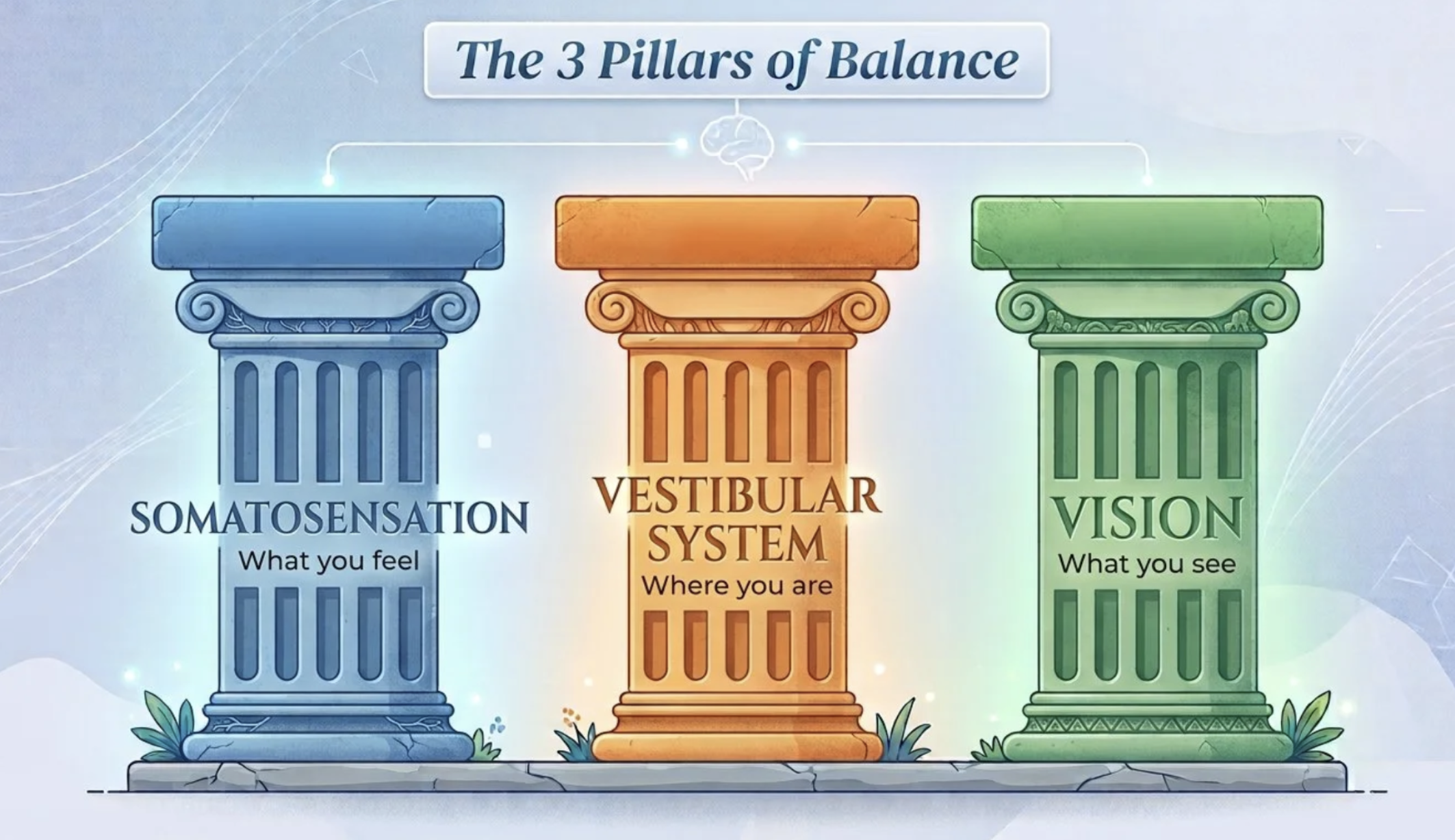
When patients come to see me with reports of dizziness, vertigo, or a vague sense that they just don't feel stable, they typically lump these experiences under the general heading of “balance problems” and assume there is a single underlying source of their difficulties. They also may think there is a single answer to fix their problem. One of the first things I explain is that balance is not a single sense. We experience balance when the integration of three different body systems works well together. Understanding how those systems work in unison is the foundation of everything I do clinically, and it's the lens through which the next several blog posts will be written.
Today I’ll talk about the Three Pillars of Balance, by which I mean the three key sensory systems that must integrate cohesively for an individual to experience balance
Pillar One: Somatosensation - What you feel
Somatosensation is your sense of touch and pressure — specifically, the information your nervous system receives from receptors in your muscles, joints, and skin. When it comes to balance, the most important source of somatosensory input is your feet and ankles. Every time you take a step, thousands of tiny receptors in the soles of your feet send signals upward: hard floor, soft grass, uneven cobblestone, slight incline. Your brain uses this information to calculate where you are in space and how to keep you upright.
This is why standing barefoot on grass feels different from standing in thick-soled shoes. It's not just comfort — your nervous system is receiving richer, more detailed information about the ground beneath you.
Pillar Two: The Vestibular System - Where you are
While the somatosensation system provides feedback about pressure against and within the body, the vestibular system is the body's dedicated motion and position sensor. Housed in the inner ear, it detects the rotation of your head, the pull of gravity, and linear acceleration. When an elevator begins to rise the somatosensation system may report the additional feeling in your feet, but the larger sensation of movement, acceleration and deceleration all come from the vestibular system. Two main structures do this work: the semicircular canals, which detect rotational movement, and the otolith organs, which detect linear movement and the orientation of your head relative to gravity.
The vestibular system is remarkably sensitive and, when something goes wrong with it, the effects can be dramatic — spinning vertigo, nausea, a persistent sense of motion. Benign paroxysmal positional vertigo (BPPV), vestibular neuritis, and Ménière's disease are all conditions that affect this system directly, and each one disrupts this pillar in a different way.
Pillar Three: Vision - What you see
While many people are aware of the role of their feet and ears on balance, some are unaware of the important role of vision. Possibly without you realizing it, your eyes are constantly scanning the environment and feeding your brain information about where the horizon is, how fast you are moving relative to your surroundings, and whether you are tilting or upright. When the visual system is healthy and well-integrated with your other senses, this happens seamlessly.
But for some people — particularly those who experience migraines, or have had vestibular injuries — the visual system can become over-relied upon. I have assessed many migraine patients using computerized posturography, which allowed me to isolate and test each sensory system independently. What I found, again and again, was that when the visual input was made unstable or unreliable, these patients struggled to maintain their balance, even when their inner ear and their feet were working just fine. They had become dependent on their eyes to feel steady. This visual dependency is one reason why busy, visually complex environments like grocery stores, shopping malls, or action movies can feel overwhelming, and even physically destabilizing, for certain patients.
The good news: this can be trained. Vestibular rehabilitation exercises can help the brain learn to use its other inputs more effectively, so that vision becomes one tool among several rather than the whole foundation.
Why Integration Is Essential
The brain must constantly integrate all three signals into a single, coherent sense of where you are. When one system sends a weak or confusing signal, the others must compensate. Problems arise when that compensation breaks down — or when the brain never learned to use all three systems efficiently.
The essential insight:
It's not enough for each pillar to function well in isolation.
This is why vestibular rehabilitation typically consists of more than a set of balance exercises; that would only address one system. More often, It is a process of evaluating the strategies a person uses, and helping the brain recalibrate how it weighs and integrates the different sensory information. And it is why, in my own practice, I find that the most effective care addresses not just the inner ear, but the whole person — how they move, how they manage stress, how their nervous system is regulated, and yes, what their feet can feel.
In the posts that follow, we'll go deeper into each of these pillars — and explore what happens when the system needs more than just exercise to heal.
Mary L. Behrens is a physical therapist in South Bend, Indiana, specializing in vestibular rehabilitation and Zero Balancing. She is a member of the Zero Balancing Faculty and the Vestibular Disorders Association, a licensed Physical Therapist and member of the American Physical Therapy Association. Learn more at marylbehrens.com.
If you have taken ZB1 and are interested in taking/retaking ZB2, please consider joining me in Indianapolis January 21-24, 2027. Here is the link to register:
https://www.zerobalancing.com/ev_calendar_day.asp?date=1/21/2027&eventid=775
Check the ZBHA website for other available classes, and feel free to reach out with any questions.